
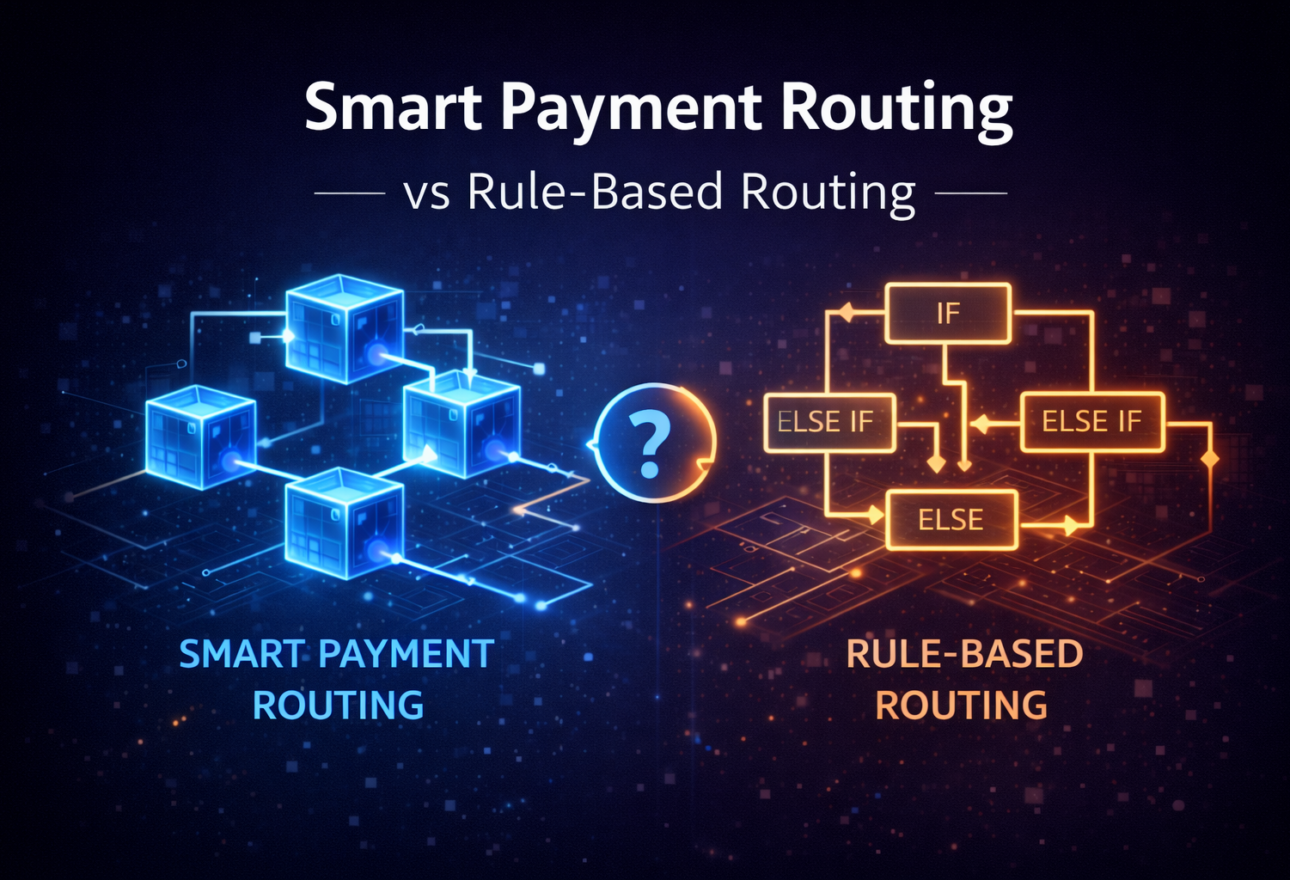
Smart payment routing is not an optimization trick. It is an architectural response to scale, volatility, and provider dependency. As payment ecosystems grow more complex, static routing rules stop working. Therefore, the difference between smart routing and rule-based routing becomes a critical design decision.
In many platforms, routing logic is still implemented as a fixed set of conditions. However, payment environments are not static. As a result, systems built on rigid rules degrade under real-world pressure.
What Smart Payment Routing Actually Means
Smart payment routing is a decision-making mechanism that dynamically selects payment execution paths based on real-time context. Instead of relying on predefined rules alone, the system evaluates multiple signals before each transaction.
These signals include provider performance, latency, approval rates, error patterns, transaction attributes, and risk indicators. Consequently, routing decisions adapt continuously rather than remaining fixed.
Unlike static routing, smart routing treats providers as variable resources. Therefore, execution paths can change without changing integrations.
How Rule-Based Routing Works
Rule-based routing relies on predefined conditions. For example, if a transaction matches a certain country, currency, or amount, it is sent to a specific provider. This logic is usually implemented as if-else chains.
At early stages, this approach feels simple. Moreover, it is easy to reason about. However, simplicity becomes a liability as complexity grows.
Each new rule increases coupling. Each exception adds fragility. As a result, routing logic becomes difficult to maintain and dangerous to modify.
Why Rule-Based Routing Breaks at Scale
Static routing assumes stable conditions. Unfortunately, payment systems operate in unstable environments.
Provider performance fluctuates. Approval rates change. Outages occur. Meanwhile, rule-based routing continues to send traffic according to outdated assumptions.
Because rules do not evaluate context dynamically, failures propagate. Therefore, approval rates drop and recovery becomes slow.
In addition, rule-based routing lacks global visibility. Decisions are made locally rather than system-wide. As a result, platforms react too late.
How Smart Payment Routing Makes Decisions
Smart payment routing operates as a continuous decision process.
Before execution, the system evaluates the transaction context. Then, it compares available providers based on current performance and constraints. After that, it selects the optimal route.
Importantly, this decision is recalculated for every transaction. Therefore, routing remains adaptive even during rapid changes.
When combined with a payment orchestration platform, smart routing becomes part of a broader control layer rather than an isolated feature.
Smart Routing and Approval Rate Optimization
Approval rates are not static metrics. They reflect provider health, routing quality, and transaction matching.
Smart payment routing protects approval rates by shifting traffic away from underperforming providers. As a result, declines are mitigated before they impact revenue.
Rule-based routing cannot do this. Because it reacts only after failures accumulate, optimization is delayed.
In contrast, smart routing anticipates degradation. Therefore, platforms maintain stability even under stress.
Latency, Performance, and Routing Intelligence
Latency affects user experience directly. However, static rules do not account for real-time response times.
Smart routing monitors execution latency continuously. When delays increase, routing decisions adjust automatically. Consequently, slow providers are deprioritized without manual intervention.
This behavior is essential for high-throughput systems. Otherwise, bottlenecks become systemic.
Smart Routing and Cascading Payments
Smart payment routing and cascading payments solve different problems. However, they work best together.
Routing determines the initial execution path. Cascading controls what happens after failure. Therefore, smart routing reduces the need for cascading, while cascading provides controlled recovery.
Without smart routing, cascading triggers too often. Without cascading, routing failures remain unresolved. Together, they form a resilient execution strategy.
Why Smart Routing Requires Orchestration
Smart routing cannot be implemented reliably at the integration level.
Provider-specific logic fragments decision-making. As a result, routing behavior becomes inconsistent. Moreover, changes require redeploying integrations.
Orchestration centralizes routing decisions. Therefore, logic evolves independently from execution.
This separation allows platforms to introduce intelligence without increasing operational risk.
When Rule-Based Routing Is Still Acceptable
At very small scale, rule-based routing may be sufficient. Simple products with limited providers can operate safely with static rules.
However, this window closes quickly. As transaction volume grows, static routing becomes technical debt.
Therefore, smart routing should be introduced before failures become systemic rather than after.
How FPEhub Implements Smart Payment Routing
At FPEhub, smart payment routing is implemented as part of the orchestration layer.
Routing logic evaluates performance, risk, and context in real time. Control mechanisms enforce limits and priorities. As a result, routing decisions remain predictable and auditable.
When platforms require deeper customization, custom fintech integrations extend routing logic to match specific business models and risk profiles.
Smart payment routing determines how your revenue flows.
If static rules are limiting performance, dynamic routing logic is the next step. FPEhub designs smart payment routing as part of an orchestration layer built for scale, control, and resilience.


