
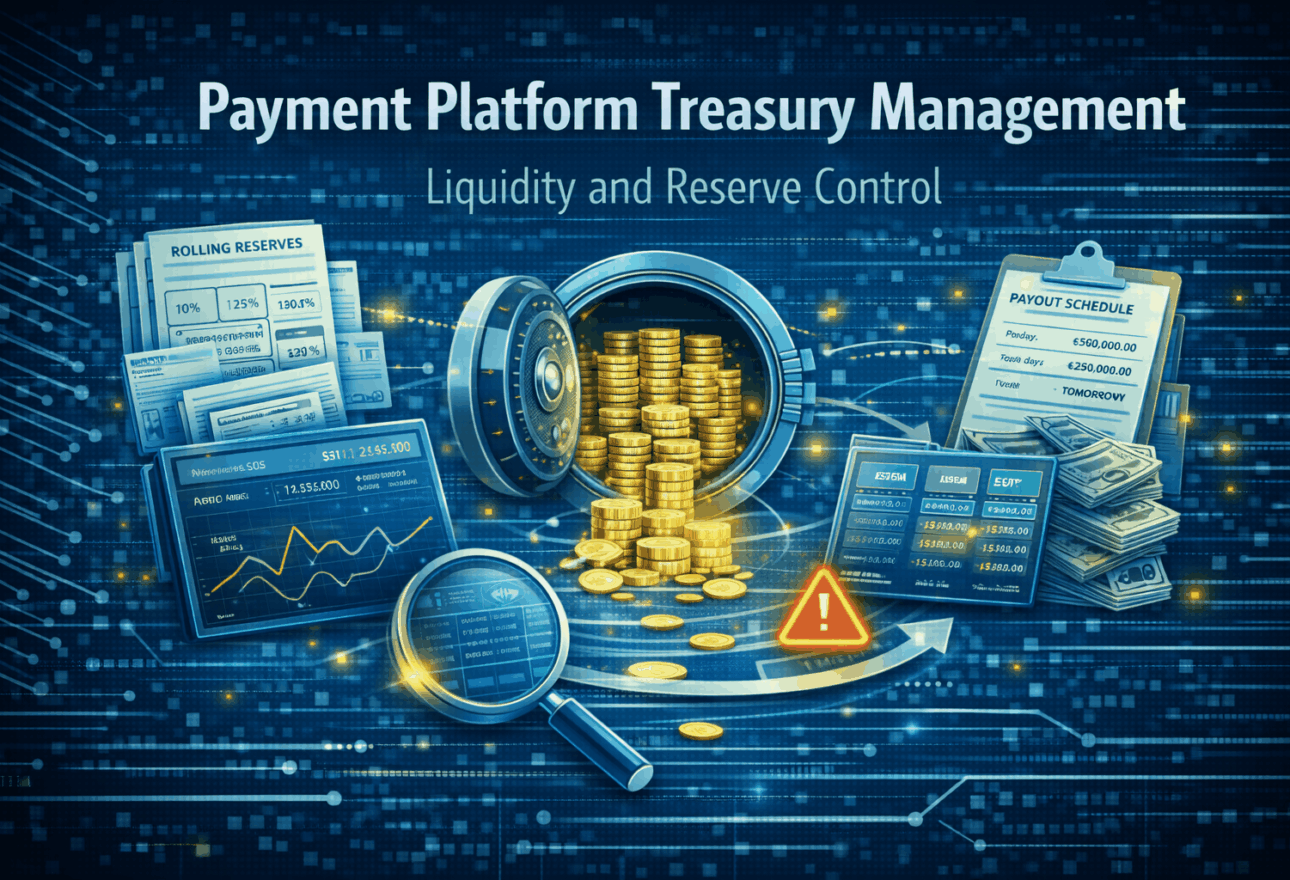
Payment Platform Treasury Management determines whether a PSP scales smoothly or collapses under liquidity pressure. While approvals generate volume, settlement timing defines cash reality. Therefore, treasury control must be engineered as part of core infrastructure.
Many founders underestimate treasury complexity. However, once volumes grow across multiple acquirers and currencies, liquidity forecasting becomes mission-critical. As a result, payment companies that ignore treasury architecture often face payout delays and partner tension.
This article explains how treasury systems connect to settlement, reserves, routing, and operational dashboards. Moreover, it outlines practical controls for sustainable growth.
Why treasury is different from accounting
Accounting records financial history. In contrast, treasury manages real-time cash position and future obligations. Therefore, treasury decisions directly influence payout reliability and risk exposure.
For example, settlement cycles may operate on T+1 or T+2 timelines. Meanwhile, merchants may request daily payouts. Consequently, liquidity gaps can appear even when revenue is strong.
Because timing mismatches are common, treasury infrastructure must model inflows and outflows continuously.
Core components of Payment Platform Treasury Management
1. Multi-acquirer settlement tracking
Each acquiring partner follows different clearing schedules. Therefore, treasury systems must track expected settlement windows per provider.
Integration with Payment Orchestration ensures routing data aligns with settlement forecasting. When traffic shifts between acquirers, liquidity projections must update accordingly.
Moreover, settlement monitoring should flag delays automatically. Early detection reduces downstream payout stress.
2. Reserve and rolling hold modeling
High-risk exposure often requires rolling reserves. However, reserve percentages cannot remain static forever. Therefore, treasury logic must incorporate dynamic reserve adjustments.
When risk levels change, reserve requirements should update immediately. Alignment with Custom Risk Routing Logic allows reserve policy to follow merchant behavior.
In addition, reserve release schedules must integrate with payout forecasting. Otherwise, treasury may miscalculate available liquidity.
3. Ledger-aligned balance control
Treasury relies on accurate ledger data. Consequently, sub-ledger precision is non-negotiable.
Integration with Core Banking ensures that platform-level balances reconcile with merchant allocations and reserve accounts.
Furthermore, multi-currency exposure requires consolidated reporting. Therefore, FX conversion and currency buffers must be visible in one unified view.
4. Payout scheduling and cash forecasting
Payout obligations represent the largest liquidity pressure. Therefore, treasury must simulate payout cycles before execution.
Forecasting should consider:
- Scheduled payout dates
- Pending settlement inflows
- Expected chargeback adjustments
- Reserve releases and holds
As a result, treasury can anticipate deficits and adjust routing or payout timing proactively.
Liquidity risk scenarios PSPs face
Liquidity stress often emerges unexpectedly. For example, an acquirer may delay settlement during a compliance review. Meanwhile, merchants continue requesting payouts.
Additionally, sudden chargeback spikes can freeze reserves. Therefore, treasury models must include stress scenarios rather than rely on optimistic averages.
In high-risk sectors, liquidity volatility increases. Consequently, treasury must coordinate closely with orchestration and risk layers.
Operational control and visibility
Treasury decisions require real-time data. Therefore, a centralized control plane becomes essential.
Through the Admin Dashboard, finance and operations teams should monitor:
- Current liquidity position
- Expected settlement inflows
- Upcoming payout obligations
- Reserve coverage ratios
Moreover, role-based permissions protect sensitive financial controls. Clear separation between treasury actions and operational monitoring reduces internal risk.
Strategic use of routing for liquidity optimization
Routing decisions influence treasury outcomes. If one acquirer settles faster, traffic allocation can improve liquidity timing. Therefore, routing should not optimize only approval rates.
In addition, fallback logic through Cascading must consider liquidity constraints. Excessive retries can inflate settlement exposure without improving net inflow.
Consequently, orchestration and treasury must share performance metrics.
Common treasury mistakes
- Relying solely on historical averages
- Ignoring cross-currency exposure
- Separating routing from liquidity forecasting
- Underestimating reserve release timing
- Failing to simulate stress events
As a result, payout delays occur even when transaction volume appears healthy.
Building a treasury-first infrastructure mindset
Payment Platform Treasury Management should influence architectural decisions early. Therefore, founders must integrate liquidity logic during platform design, not after scaling.
When treasury aligns with orchestration, ledger control, and risk segmentation, growth becomes predictable. Moreover, partner relationships strengthen because payout reliability improves.
Ultimately, sustainable payment platforms do not chase volume blindly. Instead, they balance approvals with disciplined liquidity control.


