
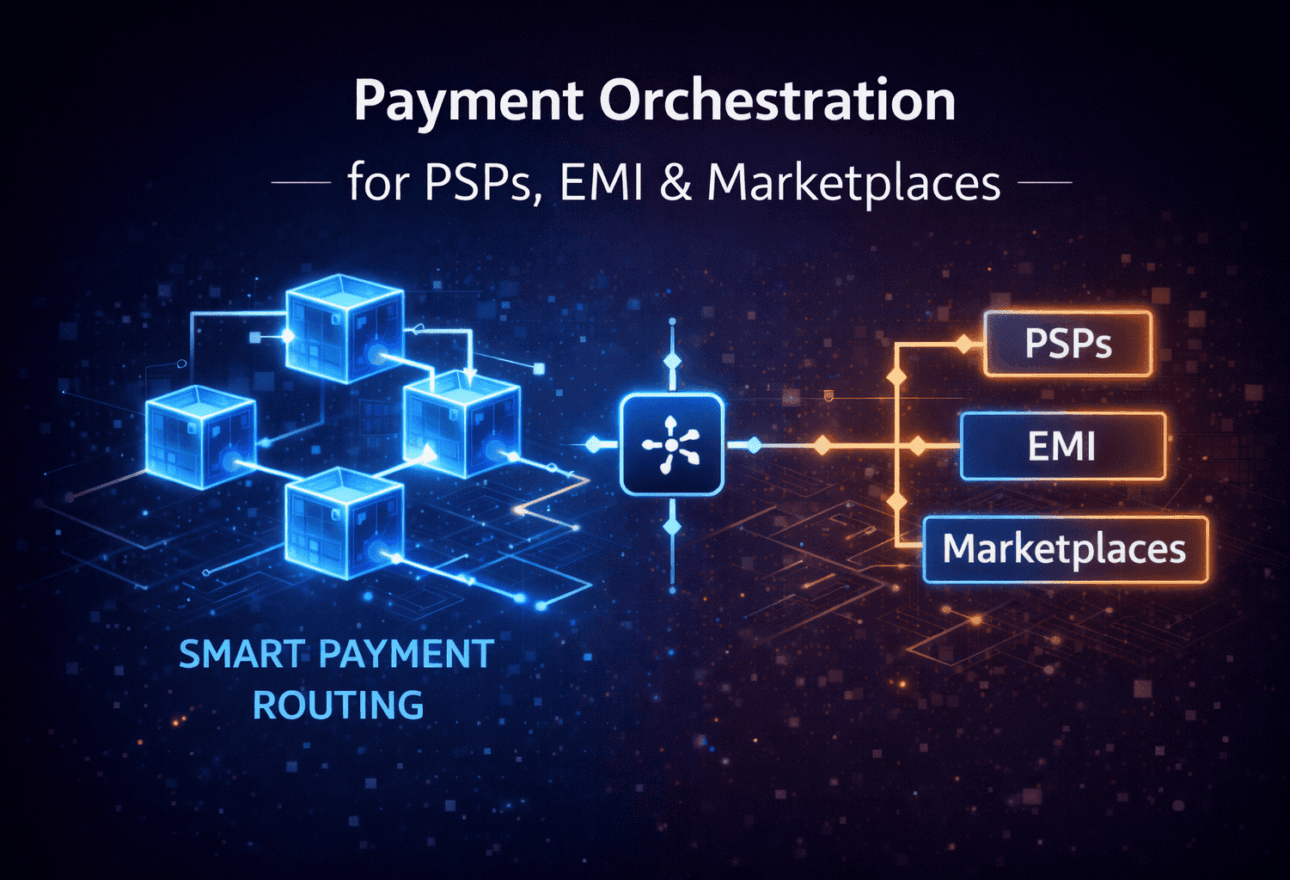
Payment orchestration for PSPs becomes critical once payment volume, regulatory pressure, and provider dependency increase. At early stages, basic routing may seem sufficient. However, as platforms scale, fragmented logic and static integrations quickly turn into operational risk.
For PSPs, EMI projects, and marketplaces, orchestration is not a feature. Instead, it is the control layer that determines how payments behave under real conditions. Therefore, understanding orchestration through segmentation is essential.
What Payment Orchestration Means for PSPs
Payment Service Providers operate in a high-pressure environment. Approval rates fluctuate. Providers degrade. Risk exposure changes constantly. Under these conditions, static payment logic fails.
Payment orchestration for PSPs centralizes decision-making. Rather than embedding rules into integrations, orchestration evaluates context before execution. As a result, routing decisions adapt in real time.
Moreover, orchestration allows PSPs to balance traffic dynamically. Provider performance, latency, and failure patterns are assessed continuously. Consequently, approval rates remain stable even during volatility.
Payment Orchestration for EMI: Compliance, Control & Scale
Electronic Money Institutions face a different challenge. Regulation, auditability, and operational transparency are critical. Therefore, orchestration for EMI projects emphasizes control and governance.
In this context, orchestration enforces compliance logic at the system level. Payment behavior becomes predictable and traceable. As a result, compliance is embedded into workflows rather than documented externally.
In addition, EMI platforms benefit from centralized visibility. Transaction flows, provider usage, and risk thresholds are monitored consistently. Consequently, scaling does not compromise regulatory control.
Marketplace Payment Orchestration: Multi-Party Logic
Marketplaces introduce structural complexity. Payments are rarely linear. Funds move between buyers, sellers, platforms, and payout accounts.
Payment orchestration enables marketplaces to manage these flows coherently. Instead of hardcoded settlement logic, orchestration coordinates multi-party execution paths. Therefore, split payments, delayed settlements, and conditional payouts remain manageable.
Without orchestration, marketplace logic fragments quickly. As a result, operational overhead grows while flexibility decreases.
Why One Platform Requires Different Orchestration Logic
Although PSPs, EMI projects, and marketplaces share infrastructure, their payment logic differs fundamentally. For this reason, orchestration must be configurable rather than templated.
A single orchestration platform can support all three models. However, decision logic, control thresholds, and execution paths must adapt to each use case. Therefore, architecture remains unified while behavior diverges.
This separation prevents duplication. At the same time, it allows platforms to evolve independently.
White Label Payment Orchestration for PSPs and EMI
White label delivery accelerates go-to-market. Nevertheless, white label does not mean reduced control.
White label payment orchestration provides PSPs and EMI projects with a ready operational shell. Branding, merchant interfaces, and onboarding flows are delivered out of the box. Meanwhile, orchestration logic remains configurable.
As a result, platforms launch faster without sacrificing flexibility. In many cases, white label frontends are combined with custom orchestration logic underneath. Therefore, speed and control coexist.
Routing, Risk & Control Across All Models
Regardless of business model, routing and risk control remain core functions. Smart payment routing ensures that execution paths adjust dynamically. Consequently, provider performance issues are mitigated before impact escalates.
In parallel, orchestration enforces risk limits. Transaction behavior is evaluated continuously. As a result, exposure remains controlled even during peak load.
This combination creates resilience. Static systems cannot achieve the same effect.
Why Payment Orchestration Fails Without Custom Engineering
Many platforms underestimate orchestration complexity. Configuration alone is not enough.
When logic becomes unique, templates reach their limits. Therefore, orchestration must be engineered, not assembled. Custom logic, control layers, and integrations are often required.
Without this flexibility, orchestration degrades into rule management. As a result, scalability is lost.
How FPEhub Builds Payment Orchestration for PSPs
At FPEhub, payment orchestration for PSPs is built as an engineering layer. Logic, routing, and control operate as a unified system.
White label delivery accelerates deployment. Meanwhile, custom fintech integrations extend orchestration behavior where business models demand precision. As a result, platforms scale without architectural rewrites.
Payment orchestration for PSPs determines how your platform scales.
If provider dependency, regulation, or marketplace complexity are limiting growth, FPEhub designs orchestration layers that combine control, flexibility, and white label delivery for real-world payment systems.


