
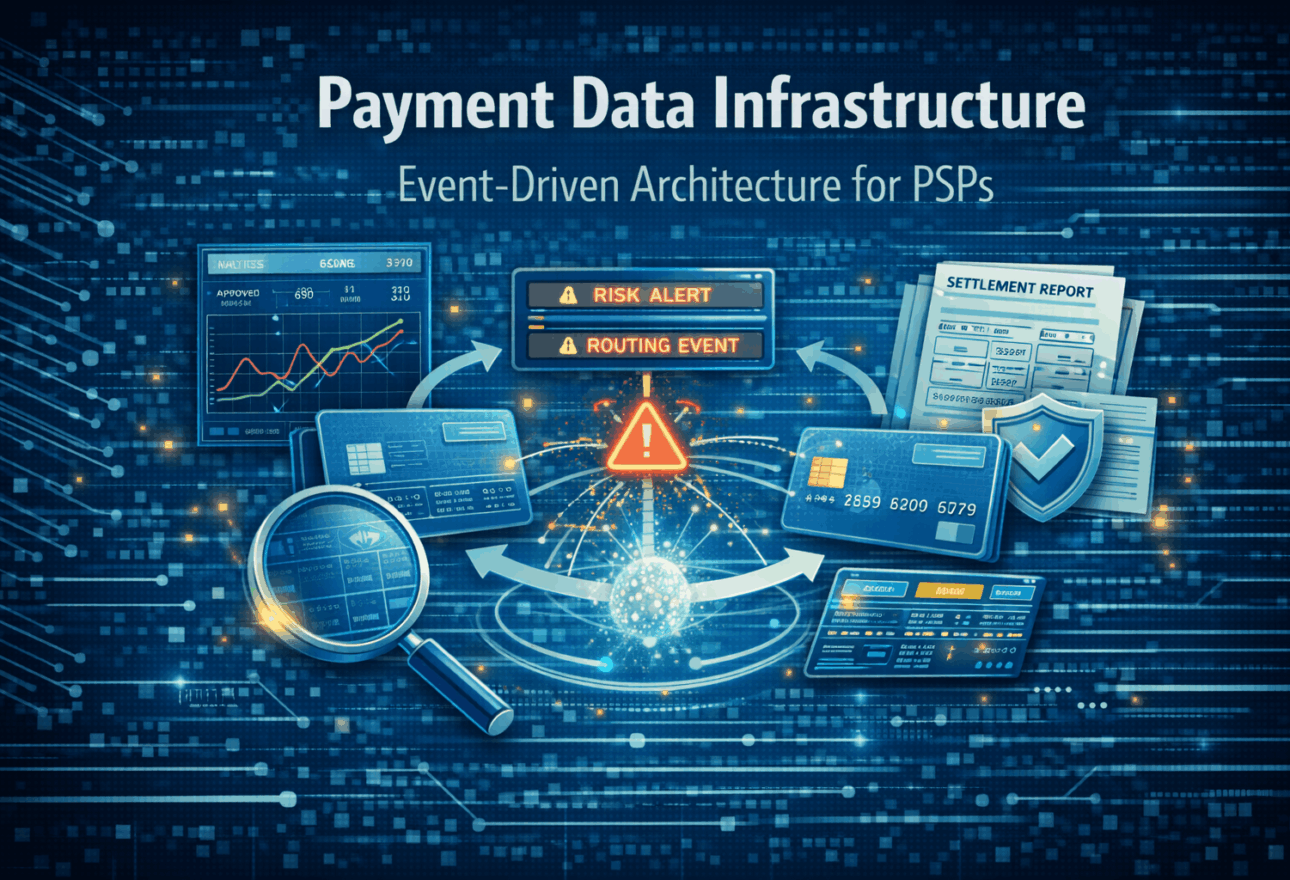
Payment Data Infrastructure determines whether a PSP can operate with clarity or with chaos. Payments generate continuous events. Each event affects routing, risk, settlement, and reporting. Therefore, a scalable platform must treat data as infrastructure, not as logs.
Many founders start with basic dashboards. However, dashboards without a structured data backbone produce misleading decisions. As a result, teams optimize the wrong metrics and miss operational risk.
This article explains how to design an event-driven data architecture for a payment platform. Moreover, it shows how data connects to orchestration, risk, and settlement control.
What “payment data” includes
Payment data is not only transaction amounts. It includes context, decisions, and outcomes across the entire lifecycle.
A mature platform typically captures:
- Authorization and capture events
- Routing decisions and connector performance
- Risk signals and rule hits
- Chargebacks, refunds, and disputes
- Settlement and reconciliation records
- Merchant configuration changes and approvals
Therefore, data must represent both financial truth and operational truth.
Why event-driven architecture fits payment platforms
Payments are state machines. Each payment transitions through states. Consequently, event-driven design maps naturally to payment reality.
In addition, event streams reduce coupling between modules. If risk logic changes, settlement tracking can remain stable. As a result, teams iterate faster without breaking core flows.
Moreover, event-driven infrastructure improves traceability. Each decision becomes explainable because the system stores decision events.
Core components of Payment Data Infrastructure
1. Event schema and normalization
First, define a unified event schema. Providers return inconsistent codes. Therefore, normalization must happen early. Otherwise, analytics becomes fragmented.
Orchestration systems already aggregate provider responses. That is why integration with Payment Orchestration is a practical foundation for clean event generation.
In addition, standardize identifiers. Transaction IDs, merchant IDs, and routing IDs should connect across every module.
2. Event ingestion and reliable delivery
Next, you need reliable ingestion. Payments produce spikes. Therefore, ingestion must tolerate burst traffic. Queueing and backpressure control become essential.
Moreover, delivery must be idempotent. Duplicate events create false analytics. As a result, the pipeline must detect and reject duplicates safely.
3. Real-time monitoring layer
Operational teams require fast visibility. Therefore, Payment Data Infrastructure must support real-time monitoring. This monitoring should cover approvals, declines, latency, and incidents.
For example, dashboards should answer:
- Which connector is failing right now?
- Which decline codes spiked in the last hour?
- Which merchants triggered velocity rules today?
Consequently, monitoring becomes a control tool, not a reporting tool. Visibility through the Admin Dashboard enables fast operational response.
4. Analytics and intelligence layer
Analytics should produce decisions, not charts. Therefore, an intelligence layer should connect data to routing and risk optimization.
When routing has access to clean performance metrics, it can adapt. Integration with Smart Payment Routing depends on accurate, segmented data.
Similarly, risk systems require historical patterns. Therefore, data pipelines must feed rule tuning and risk scoring. Integration with Custom Risk Routing Logic becomes more effective when rule hit rates are measurable.
5. Financial data integrity and ledger alignment
Payment data includes money movement. Therefore, it must reconcile with ledger truth. If analytics reports do not match balances, trust collapses.
Consequently, financial events should align with ledger updates. Platforms that manage balances often require Core Banking discipline to maintain sub-ledger accuracy.
Data governance and audit readiness
Payment platforms operate under scrutiny. Therefore, data governance must be built in. Audit trails should be immutable. Access must be controlled. Moreover, retention policies must be defined.
Governance typically requires:
- Immutable logs for critical actions
- Role-based access control
- Versioning of routing and risk policies
- Evidence storage for compliance decisions
In addition, merchant-related actions must be traceable. A structured Merchant Management layer supports governance by centralizing merchant state changes.
How payment data improves approvals and margins
Approval optimization requires measurement. Therefore, you must segment approvals by issuer, BIN range, country, method, and merchant type.
When segmentation is accurate, routing can adapt. For example, the platform can route certain BIN ranges away from underperforming connectors. As a result, approvals improve without additional providers.
Moreover, data reveals cost patterns. Fee differences and decline behavior affect margin. Therefore, data infrastructure becomes a profitability engine.
Common mistakes founders make
- Tracking only high-level approval metrics
- Storing provider responses without normalization
- Building dashboards without event integrity
- Separating financial reporting from operational monitoring
- Ignoring auditability and policy versioning
As a result, the platform scales activity but not control.
Strategic advantage of owning Payment Data Infrastructure
Payment Data Infrastructure turns your platform into a learning system. It connects routing, risk, settlement, and merchant operations into one coherent model.
Therefore, teams can iterate faster. They can explain decisions. They can respond to incidents in minutes. Moreover, they can defend their performance to partners.
Ultimately, payment companies that own their data backbone build durable infrastructure. Those that treat data as an afterthought remain dependent and reactive.


