
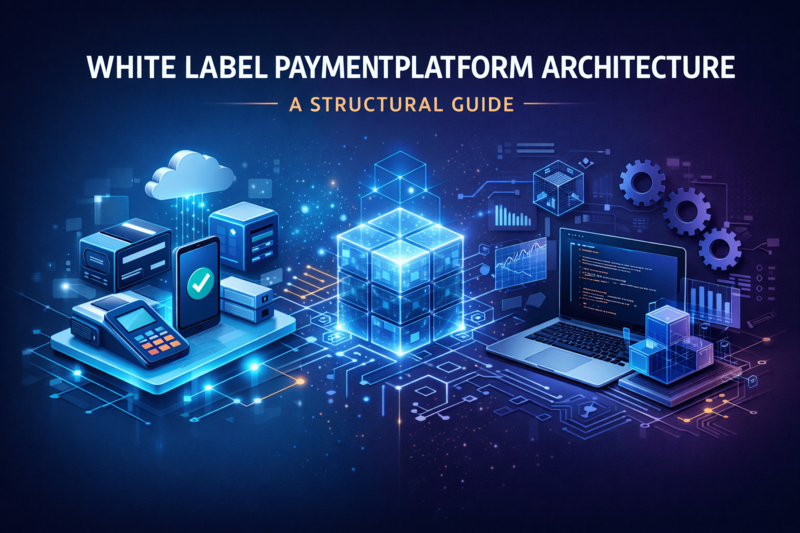
White label payment platforms may look simple on the surface.
However, their internal architecture is complex, modular, and tightly regulated.
To understand their real value, you must look beyond interfaces.
You must understand how these platforms are engineered.
This article explains how modern white label payment platforms are built.
It also shows why architecture matters more than features.
Why Architecture Matters in White Label Fintech
Payment platforms operate in regulated environments.
They process money, identity data, and risk signals.
Therefore, architectural decisions directly affect stability, scalability, and compliance.
A poorly designed platform limits growth.
A well-designed one enables expansion without rebuilds.
That difference starts at the system level.
Core Architecture of a White Label Payment Platform
A modern white label platform is not a single system.
Instead, it is a layered architecture.
Each layer has a clear responsibility.
Together, they form a controlled financial environment.
At a high level, architecture is divided into four core layers.
Infrastructure Layer
The infrastructure layer is the foundation.
It includes hosting, networking, security, and data storage.
This layer must be resilient by design.
Downtime is not acceptable in payments.
Therefore, redundancy, isolation, and monitoring are built in from day one.
Infrastructure also defines regional deployment.
This is critical for regulatory alignment.
Core Payment Engine
The payment engine handles transaction logic.
It processes authorizations, settlements, and reversals.
More importantly, it enforces rules.
Limits, routing logic, and validation live here.
This engine must be deterministic.
Every transaction must be traceable.
As a result, auditability is built into the core.
Integration & Orchestration Layer
White label platforms rely on external providers.
Banks, PSPs, KYC vendors, and fraud tools must connect seamlessly.
This is where orchestration comes in.
Instead of hardcoding integrations, platforms use abstraction layers.
Each provider follows a unified interface.
Therefore, providers can be replaced without breaking the system.
This layer is also where smart routing happens.
Transactions follow dynamic paths based on rules and context.
Compliance & Risk Layer
Compliance is not an add-on.
It is embedded directly into workflows.
KYC, AML, transaction monitoring, and reporting operate continuously.
They do not block the system.
They guide it.
For example, risk scoring may affect routing decisions.
In addition, compliance flags may trigger operational controls.
As a result, regulation becomes executable logic.
Admin & Control Interfaces
Every white label platform includes internal tools.
These tools are not cosmetic.
Admin dashboards control merchants, limits, users, and risk rules.
Operations teams rely on them daily.
Therefore, access control and logging are critical.
Every action must be visible and reversible.
API & Extension Layer
White label does not mean closed.
Modern platforms expose APIs.
These APIs allow custom flows, external services, and automation.
They also enable differentiation.
As a result, white label becomes extensible.
This is where custom fintech integrations are implemented safely.
Multi-Tenant Design Principles
White label platforms serve multiple clients.
However, data must remain isolated.
Therefore, multi-tenancy is enforced at the architectural level.
Not just at the interface.
Each tenant has separate configurations, limits, and permissions.
Yet the core system remains shared.
This balance is essential for scalability.
Security by Architecture, Not Policy
Security is structural.
It is not a checklist.
Encryption, access control, and segmentation are built into every layer.
In addition, monitoring operates in real time.
As a result, incidents are detected early.
Response becomes systematic, not reactive.
How White Label Platforms Scale
Scaling is not about adding servers.
It is about architectural elasticity.
Event-driven components allow horizontal growth.
Stateless services reduce coupling.
Therefore, platforms scale without redesign.
This is why architecture decisions made early matter later.
Where FPEhub’s Approach Differs
FPEhub designs white label platforms as engineering systems.
Not as packaged products.
We build modular cores.
We design extension layers intentionally.
As a result, clients are not locked into rigid frameworks.
White label becomes a foundation.
Custom development becomes an evolution, not a rewrite.


