
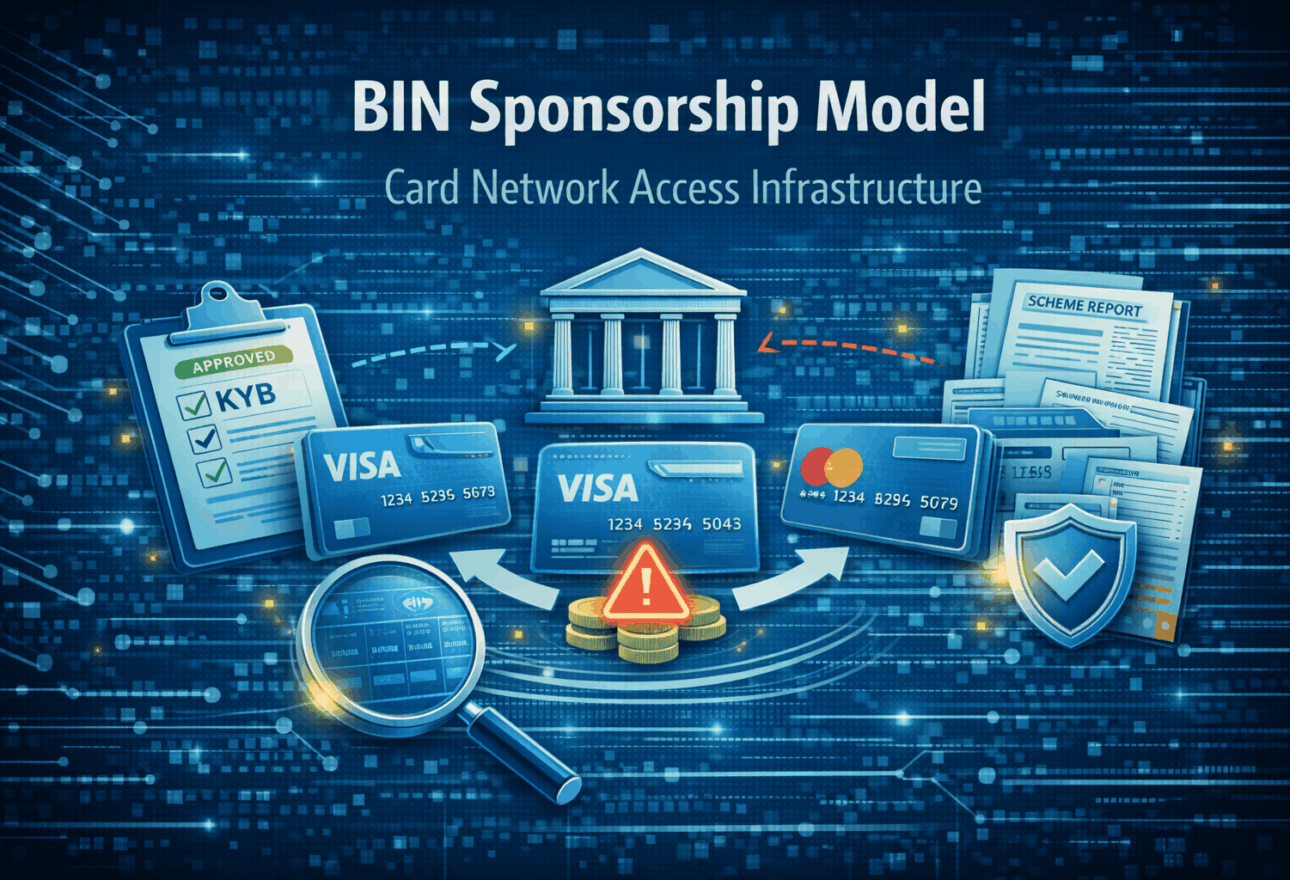
BIN Sponsorship Model defines how a payment company connects to card networks without becoming a principal member. While many founders focus on gateway APIs, real infrastructure begins at scheme level. Therefore, understanding sponsorship structure is critical for long-term scalability.
Card processing requires access to Visa and Mastercard rails. However, direct scheme membership is complex and capital-intensive. As a result, many PSPs operate under a sponsoring bank that provides regulated access.
This article explains how BIN sponsorship works, how it connects to acquiring and routing, and how infrastructure must support compliance and operational control.
What BIN sponsorship actually means
BIN stands for Bank Identification Number. It represents the first digits of a card number and identifies the issuing institution. Under a BIN Sponsorship Model, a licensed bank allows a fintech or PSP to operate under its scheme membership.
Instead of becoming a principal member, the payment company integrates through the sponsor’s regulatory umbrella. Consequently, scheme reporting, compliance, and settlement responsibilities flow through the sponsoring institution.
This structure enables faster market entry. Nevertheless, it introduces dependency and oversight requirements.
Principal membership vs sponsorship
Principal membership grants direct access to card schemes. However, it requires substantial capital reserves, compliance audits, and ongoing reporting obligations.
In contrast, a BIN Sponsorship Model reduces entry barriers. Therefore, early-stage gateways and fintech platforms often choose sponsorship before scaling toward independence.
- Principal Member: Direct scheme relationship and full responsibility.
- Sponsored Entity: Operates under a regulated sponsor bank.
- Aggregator Structure: May combine sponsorship with acquiring services.
Each model affects revenue structure, compliance exposure, and reporting logic.
How sponsorship integrates with payment infrastructure
1. Scheme connectivity layer
The sponsor bank maintains direct scheme connections. The PSP connects through technical interfaces defined by the sponsor. Therefore, infrastructure must normalize scheme data before it reaches internal systems.
Integration with Core Payments ensures that authorization and clearing events remain consistent across sponsored and direct acquiring channels.
2. Acquiring alignment
Sponsorship does not replace acquiring relationships. Instead, it complements them. Consequently, orchestration logic must coordinate between acquiring connectors and sponsor-level constraints.
Alignment with Payment Orchestration enables routing decisions that respect sponsor exposure limits.
3. Compliance reporting
Under sponsorship, the sponsor bank bears regulatory accountability. However, the PSP must supply accurate transaction data and merchant information.
Therefore, onboarding discipline becomes critical. A structured Merchant Management system ensures sponsor reporting remains accurate and auditable.
Operational responsibilities inside a BIN Sponsorship Model
Even though the sponsor provides scheme access, operational control remains with the PSP. The platform must manage:
- Merchant onboarding and KYB verification
- Transaction monitoring and fraud detection
- Chargeback handling and dispute management
- Settlement reconciliation and reserve tracking
Consequently, sponsorship does not eliminate compliance effort. Instead, it formalizes oversight.
Integration with Admin Dashboard controls supports sponsor audits and real-time monitoring.
Risk exposure and sponsor limits
Sponsor banks define exposure thresholds. These limits may include transaction volume caps, vertical restrictions, and chargeback ceilings.
Therefore, routing and underwriting must align with sponsor constraints. Integration with Custom Risk Routing Logic allows platforms to enforce sponsor-specific restrictions automatically.
Moreover, proactive monitoring reduces escalation risk. If thresholds approach critical levels, traffic distribution can adjust dynamically.
Settlement and reporting implications
Settlement under sponsorship often routes through sponsor-controlled accounts. Consequently, reconciliation logic must reflect sponsor reporting formats.
Ledger alignment through Core Banking strengthens multi-currency control and reserve calculation accuracy.
In addition, scheme reporting cycles require consistent data exports. Therefore, infrastructure must support scheduled reporting automation.
Advantages of a BIN Sponsorship Model
- Faster entry into card processing markets
- Reduced upfront regulatory burden
- Access to established scheme relationships
- Structured compliance supervision
These benefits enable early scalability. However, dependency remains a strategic consideration.
Common misconceptions founders have
- Assuming sponsorship removes compliance obligations
- Believing sponsor oversight is minimal
- Ignoring scheme reporting complexity
- Failing to align routing logic with sponsor limits
- Underestimating operational audit requirements
As a result, some platforms face sudden partner restrictions or contract termination.
Strategic roadmap: when to move beyond sponsorship
In early growth stages, sponsorship accelerates deployment. Over time, transaction volume and capital reserves may justify direct scheme membership.
Therefore, infrastructure should remain modular. Connector abstraction and reporting discipline ease the transition from sponsored to principal models.
Ultimately, the BIN Sponsorship Model is not merely a legal arrangement. It is a structural component of payment architecture that influences compliance, routing, and financial control.


