
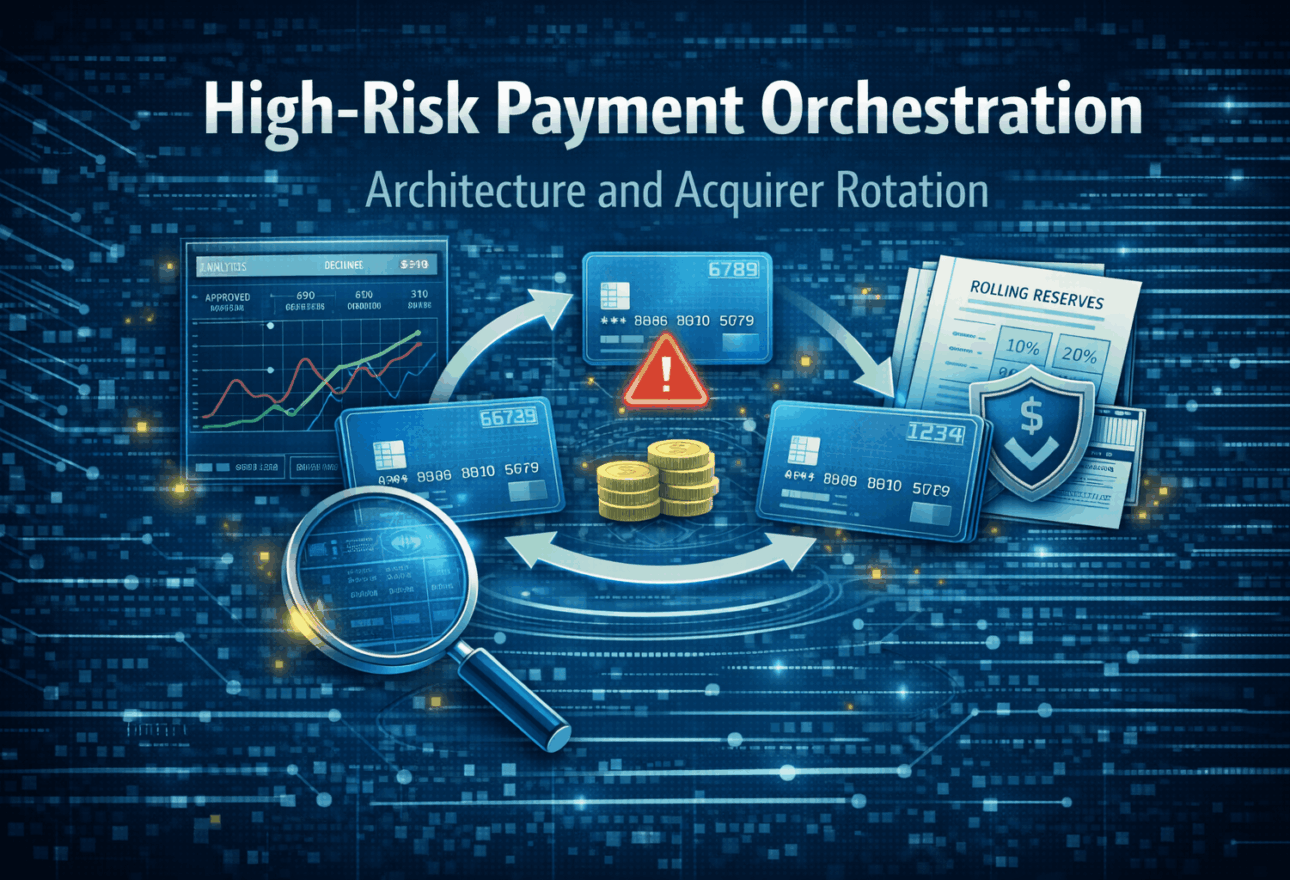
High-Risk Payment Orchestration determines whether volatile industries survive or collapse under decline pressure. While standard gateways focus on connectivity, high-risk environments demand adaptive infrastructure. Therefore, orchestration becomes a defensive and offensive control layer at the same time.
Industries such as iGaming, nutraceuticals, subscription continuity models, and cross-border digital services operate under constant scrutiny. Approval volatility, acquirer policy shifts, and chargeback sensitivity define daily operations. As a result, static routing logic fails quickly.
This article explains how orchestration architecture supports high-risk verticals through acquirer rotation, reserve control, and routing intelligence.
Why high-risk businesses require orchestration depth
Traditional payment setups rely on one or two acquirers. However, high-risk sectors experience frequent underwriting changes. Consequently, dependency on a single provider creates existential exposure.
Moreover, issuer behavior varies by region and card type. Therefore, routing must respond dynamically to decline patterns rather than follow fixed rules.
Integration with a flexible Payment Orchestration layer enables traffic segmentation and real-time policy adjustment.
Core infrastructure components for high-risk orchestration
1. Acquirer rotation framework
Acquirer rotation distributes traffic across multiple providers. Instead of equal splits, the system allocates based on performance and exposure.
For example:
- Primary acquirer handles low-to-medium risk traffic.
- Secondary acquirer processes sensitive BIN ranges.
- Specialized providers accept region-specific flows.
When one acquirer tightens policy, traffic shifts gradually rather than abruptly. Therefore, business continuity remains stable.
2. Decline pattern analysis
High-risk approval optimization depends on understanding issuer responses. Hard declines differ from soft declines. Consequently, routing must interpret response codes intelligently.
Integration with Smart Payment Routing enables performance-based adjustments rather than blind retries.
In addition, structured Cascading logic ensures controlled fallback when retry conditions are valid.
3. Risk-tier segmentation
Not all merchants within a high-risk category behave identically. Therefore, orchestration must support granular segmentation.
Segmentation may include:
- Merchant-level chargeback ratios
- Product-level sensitivity
- Geographic exposure
- Historical refund behavior
When integrated with Custom Risk Routing Logic, segmentation becomes configurable without redeployment.
Reserve management in high-risk environments
Rolling reserves protect acquirers and platforms. However, reserve structures must adapt to merchant behavior.
Therefore, orchestration should connect to ledger logic and reserve calculations. When chargeback thresholds rise, reserve percentages can adjust automatically.
Alignment with Core Banking supports accurate sub-ledger tracking and controlled fund release.
Geographic routing complexity
High-risk verticals often operate globally. Issuer tolerance differs across markets. Consequently, orchestration must consider geography explicitly.
Routing decisions may evaluate:
- Domestic vs cross-border acquiring
- Local currency processing
- Regulatory sensitivity by region
When combined with Fintech Regulatory Adaptation, routing aligns with compliance constraints rather than bypassing them.
Operational monitoring and control
High-risk orchestration requires continuous oversight. Approval rates, decline distribution, and chargeback velocity must be tracked in near real time.
Visibility through the Admin Dashboard enables rapid adjustments when performance shifts.
Moreover, analytics should detect abnormal retry spikes or issuer bans early. Therefore, monitoring becomes preventive rather than reactive.
Common orchestration mistakes in high-risk sectors
- Retrying hard declines automatically
- Routing traffic evenly without performance segmentation
- Ignoring acquirer exposure limits
- Failing to adjust reserves dynamically
- Separating risk logic from routing logic
As a result, approval rates deteriorate and partner relationships weaken.
Strategic advantage of High-Risk Payment Orchestration
High-Risk Payment Orchestration converts volatility into structured control. While industry dynamics remain unpredictable, infrastructure can remain disciplined.
By combining acquirer rotation, intelligent routing, reserve governance, and real-time monitoring, platforms transform instability into managed variability.
Ultimately, in high-risk environments, orchestration is not an optimization layer. It is a survival mechanism embedded inside payment architecture.


