
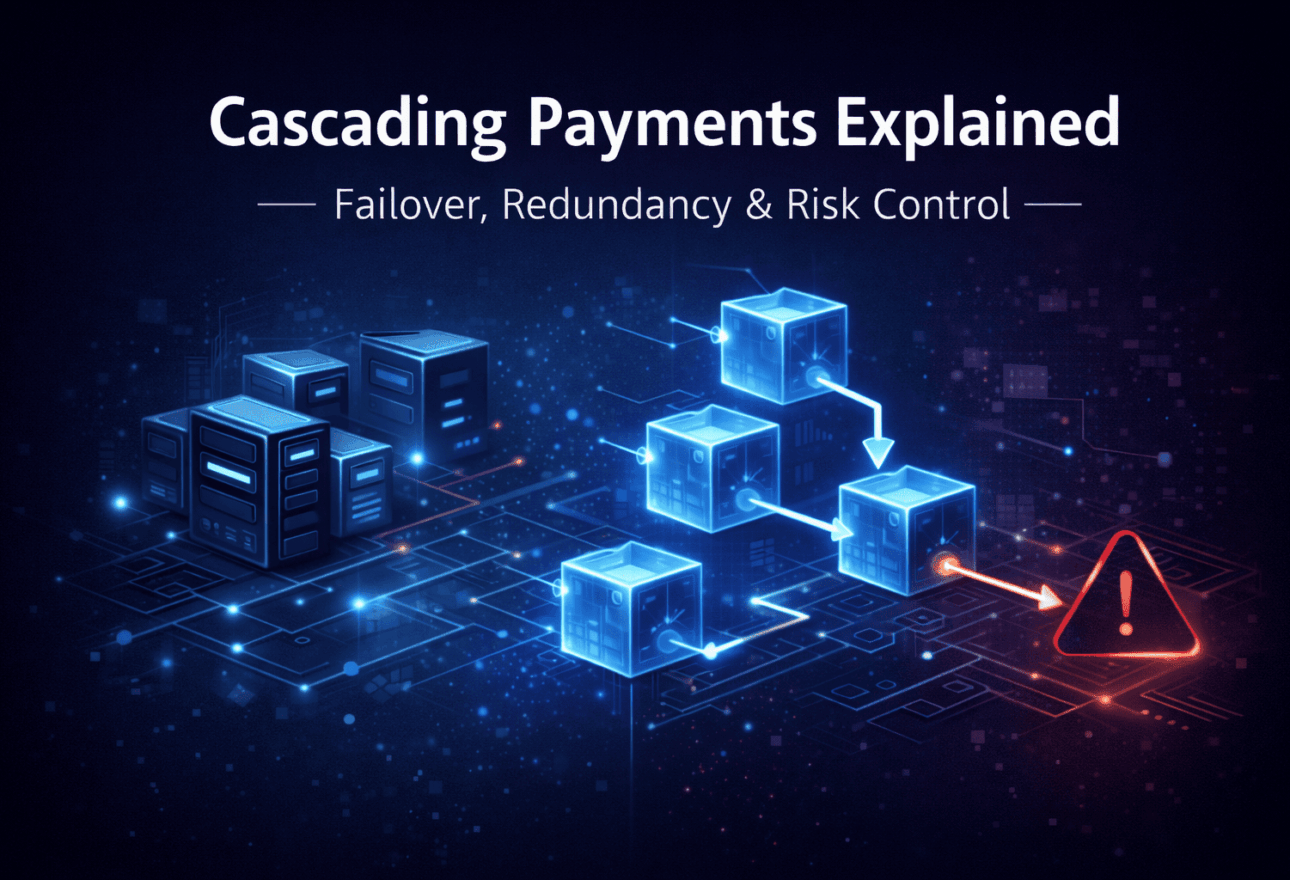
Cascading payments are not retries. They are not backup routes either. Instead, cascading payments represent a controlled execution mechanism that protects payment flows when providers fail, performance drops, or risk thresholds are exceeded. As payment systems scale, this mechanism becomes essential.
However, many platforms still confuse cascading with basic error handling. As a result, payment failures propagate through the system. Therefore, cascading must be implemented as part of orchestration logic, not as an afterthought.
What Cascading Payments Actually Are
Cascading payments describe a structured process where a transaction moves through predefined execution paths when initial attempts fail. The key point is control. Each step is governed by logic, conditions, and limits.
In contrast to simple retries, cascading evaluates context before every attempt. It decides whether to continue, switch providers, delay execution, or stop entirely. Therefore, cascading payments are decision-driven rather than reactionary.
Moreover, cascading is not provider-specific. It operates at the platform level. As a result, execution paths remain flexible even when providers change.
Cascading Payments vs Retries
Retries repeat the same action. Cascading changes the action.
When a retry fails, the system usually repeats the request with minimal variation. This may help with transient errors. However, it does not address structural issues such as provider outages or degraded approval rates.
Cascading payments work differently. After a failure, the platform reassesses conditions. Then, it selects an alternative execution path. Therefore, cascading actively mitigates risk instead of amplifying it.
In addition, retries increase load on failing providers. Cascading reduces dependency on any single provider. As a result, system stability improves.
Failover as a Controlled Mechanism
Failover is often described as automatic switching. However, uncontrolled failover introduces new risks.
In a cascading payments model, failover is conditional. The platform evaluates why a transaction failed. It checks error types, provider health, and risk signals. Only then does it activate the next path.
This approach prevents blind traffic shifts. Therefore, platforms avoid cascading failures across providers. Moreover, failover becomes predictable and auditable.
Redundancy at the Orchestration Level
True redundancy is not achieved by adding more providers. It is achieved by controlling how providers are used.
Cascading payments enable redundancy by decoupling execution from decision-making. The orchestration layer defines multiple viable paths. Execution follows those paths only when conditions allow.
As a result, redundancy becomes dynamic. Providers can be activated or bypassed in real time. Therefore, payment flows remain resilient under stress.
This logic works best within a payment orchestration platform, where decisions are centralized and execution remains distributed.
Risk Control Through Cascading Logic
Risk control is a core function of cascading payments. Each execution attempt carries exposure.
Cascading logic enforces limits. It caps retries. It restricts provider switching. It evaluates transaction context continuously. Therefore, risk does not compound silently.
In addition, cascading allows platforms to protect approval rates. When a provider’s performance drops, traffic is redirected selectively. As a result, overall conversion remains stable.
This is not possible with static routing. It requires real-time decisions and visibility.
Cascading Payments in Real Payment Flows
In practice, cascading payments operate as a decision loop.
A transaction enters the system. The platform attempts execution through the primary path. If the attempt fails, the system evaluates the failure. Then, it selects the next action.
This action may involve switching providers, delaying execution, or stopping the flow. Importantly, every step is logged and controlled. Therefore, operations teams retain full visibility.
Cascading also integrates tightly with smart payment routing, which determines optimal paths before execution begins. Together, these mechanisms form a resilient payment backbone.
Why Cascading Fails Without Orchestration
Many platforms attempt to implement cascading at the integration level. This approach does not scale.
Without orchestration, logic becomes fragmented. Each provider integration handles failures differently. As a result, behavior becomes inconsistent and unpredictable.
Moreover, integration-level cascading lacks global context. Decisions are made without system-wide visibility. Therefore, risk control degrades.
Cascading payments require a centralized logic layer. Without it, cascading becomes guesswork.
Cascading Payments for Fintech Platforms and PSPs
For fintech platforms, cascading protects user experience. Failed payments are resolved transparently. Therefore, trust is preserved.
For PSPs, cascading protects revenue. Traffic is distributed intelligently. Provider dependency is reduced. As a result, operational efficiency improves.
In both cases, cascading payments enable scale without fragility.
How FPEhub Implements Cascading Payments
At FPEhub, cascading payments are implemented as part of the orchestration layer. Logic, routing, and control operate together.
Execution paths are defined explicitly. Conditions are evaluated continuously. Risk thresholds are enforced systematically. Therefore, cascading becomes predictable and manageable.
This approach allows platforms to evolve payment behavior without rebuilding infrastructure. For teams requiring advanced control, custom fintech integrations extend cascading logic to match exact business requirements.
Payment failures should not decide your revenue.
If your platform needs controlled failover, real redundancy, and embedded risk control, cascading payments must be implemented at the orchestration level. Talk to FPEhub about building cascading logic through custom fintech integrations designed for scalable payment systems.


