
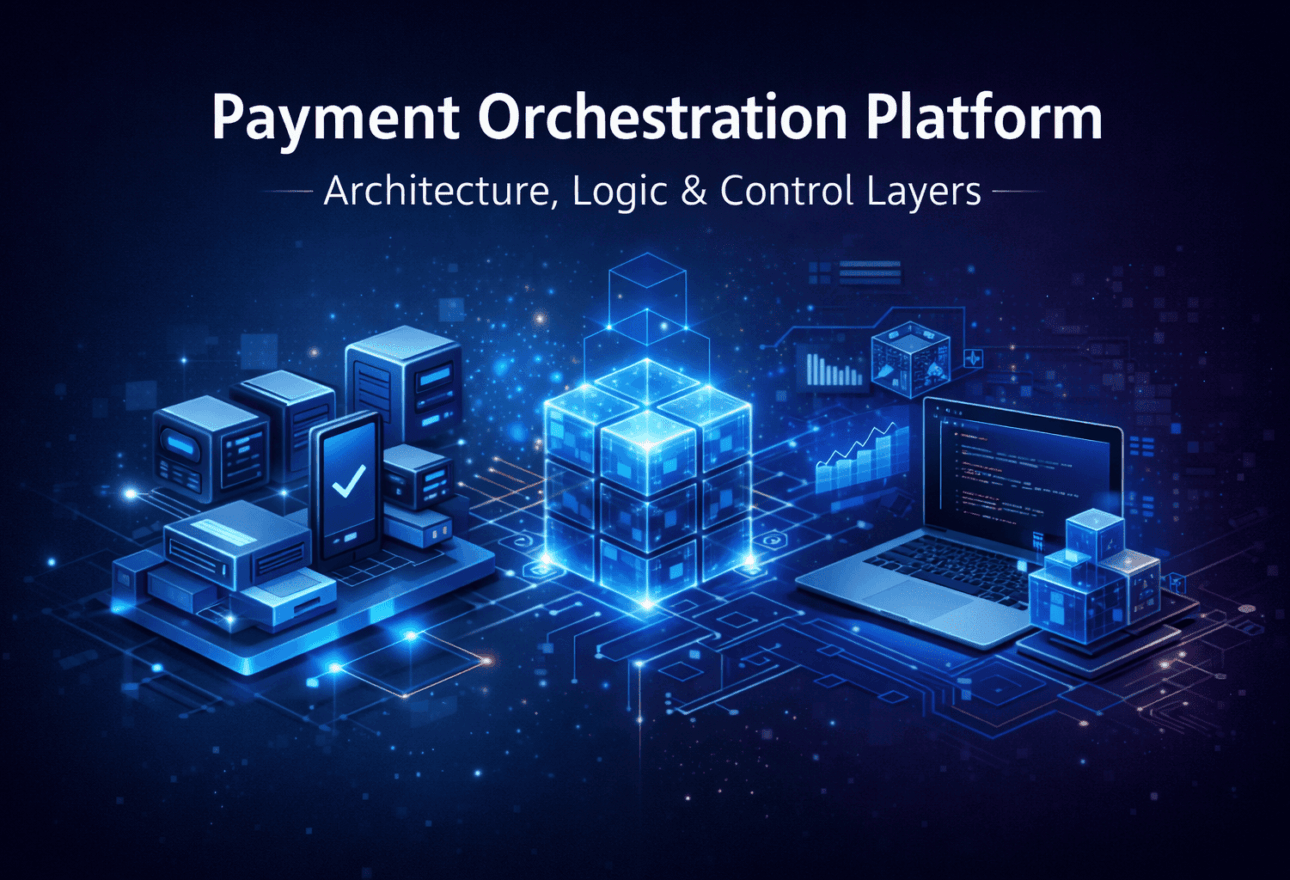
A payment orchestration platform is not a payment gateway and not a PSP. It is an architectural control layer that governs how payments are decided, routed, executed, and supervised across multiple providers and payment flows. As transaction volumes increase, business logic becomes more complex. At that point, orchestration stops being optional and becomes foundational.
However, many fintech platforms still attempt to scale payments by adding more gateways. As a result, logic becomes fragmented and brittle. Therefore, orchestration must be treated as a system layer, not an integration shortcut.
What Is a Payment Orchestration Platform
A payment orchestration platform is a centralized decision and control system that sits above payment providers. Instead of embedding logic into provider integrations, orchestration separates decision-making from execution.
In contrast to a traditional payment gateway, orchestration does not focus on processing transactions. Instead, it determines how each transaction should be handled before execution begins. Therefore, providers become execution endpoints rather than logic owners.
Moreover, orchestration allows platforms to change payment behavior without rewriting integrations. As a result, payment systems remain adaptable even as business requirements evolve.
Core Architecture of a Payment Orchestration Platform
A robust payment orchestration architecture is built as a layered system. Each layer has a defined responsibility. Together, they form a controllable and scalable payment backbone.
Logic Layer: How Payment Decisions Are Made
The logic layer defines how payment decisions are produced. It evaluates transaction context, merchant configuration, risk signals, geography, currency, and business rules. Based on these inputs, it determines the optimal payment path.
This layer must remain provider-agnostic. Otherwise, orchestration collapses into gateway logic. Therefore, rules, conditions, and scenarios must live independently from execution code.
In addition, a mature logic layer supports versioning. This allows teams to adjust behavior gradually. As a result, platforms can test new strategies without disrupting live traffic.
Routing & Execution Layer
Once a decision is made, the routing and execution layer carries it out. This layer translates abstract decisions into provider-specific actions.
Here, the system selects providers, manages priorities, controls retries, and handles execution timing. Importantly, provider differences are hidden behind a unified interface.
This is where smart payment routing becomes critical. Instead of static rules, routing adapts to real-time performance and availability. As a result, approval rates improve while operational risk decreases.
The execution layer must also minimize latency. Otherwise, orchestration introduces friction. Therefore, this layer is engineered for speed, determinism, and fault tolerance.
Control & Governance Layer
The control layer provides visibility and enforcement across the entire payment system. It monitors provider health, approval rates, error patterns, and risk thresholds in real time.
Based on this data, the platform can intervene dynamically. For example, traffic can be throttled or rerouted automatically. Therefore, revenue protection becomes proactive rather than reactive.
In addition, governance mechanisms enable auditing and traceability. This is essential for regulated environments. As a result, compliance is enforced through system behavior rather than manual procedures.
How a Payment Orchestration Platform Works in Real Flows
In a real payment flow, orchestration operates as a continuous decision loop.
First, a transaction request enters the platform. The logic layer evaluates context and rules. Then, a routing decision is produced. After that, execution begins through the selected provider.
If execution fails, fallback logic is triggered automatically. The system may retry, switch providers, or apply alternative paths. These mechanisms are commonly known as cascading payments.
Throughout the process, the control layer observes outcomes. Therefore, future decisions can adapt based on performance. As a result, orchestration improves system efficiency over time.
Payment Orchestration vs Traditional Payment Gateways
Traditional payment gateways are designed primarily for execution. They connect merchants to providers and expose standardized APIs. However, they embed logic directly into integration flows.
This approach works at low complexity. However, it breaks down as scale increases. Each new rule adds coupling. Each provider change introduces risk.
In contrast, a payment orchestration platform externalizes logic and centralizes control. Providers become interchangeable. Decisions become configurable. Therefore, the platform scales without accumulating architectural debt.
Moreover, gateways lack system-wide visibility. Orchestration platforms provide holistic oversight. As a result, operational teams can manage payments strategically rather than tactically.
Who Needs a Payment Orchestration Platform
Payment orchestration is essential for platforms operating across multiple providers, markets, or business models.
Fintech platforms require orchestration to manage diverse payment methods and regulatory contexts. PSPs rely on orchestration to optimize approval rates and provider utilization. Marketplaces depend on orchestration to coordinate complex payment flows across participants.
In each case, the underlying need is the same. Control must be centralized while execution remains distributed.
Why Payment Orchestration Fails Without Custom Engineering
Many orchestration initiatives fail because they rely on rigid templates. While white-label solutions can accelerate early stages, they impose limits on logic and control.
As payment complexity grows, static configurations become insufficient. Therefore, orchestration must evolve alongside the platform. This requires custom engineering at the logic and control layers.
Without this flexibility, orchestration degrades into a collection of rules. As a result, scalability is lost.
Why FPEhub Builds Payment Orchestration as an Engineering Layer
At FPEhub, payment orchestration is treated as an engineering discipline. It is not a product feature. It is a system layer embedded into platform architecture.
Logic, routing, and control are designed to evolve. Therefore, payment behavior adapts without rewriting infrastructure. This approach allows platforms to scale sustainably while maintaining control.
If your payment system is reaching its limits, orchestration is not the next integration. It is the next architectural step. For platforms requiring advanced logic and control, custom fintech integrations provide the foundation for that transition.


